

Scholarships sprout innovation in organic growing
Alex McDonald is turning microgreens into a lucrative organic business. Shari Corbett-Dwyer has launched an innovative community garden support network to encourage more food growing and sharing at a neighbourhood level.
The former WITT students who graduated this year with the New Zealand Certificate in Organic Primary Production (Level 4) are proving that organic food production can be good business while fostering resilient communities.
Both recipients of scholarships funded by the Bishop’s Action Foundation, they’ve gained not only knowledge about to grow food organically but also learned about the systems that govern certification of organic production and the processes for success in a business sense.
Alex, who also received the Bashford-Nicholls Trust Award for Top Student (worth $500) for 2025, is using the knowledge from the Level 4 programme to develop a commercial venture around growing microgreens - young, nutrient-dense edible green shoots harvested two to three weeks after germination. Popular types include broccoli, kale, radish, rocket, coriander, and sunflower. They often contain higher concentrations of vitamins, minerals, and antioxidants compared to their mature counterparts and offer intense flavours.
She decided to focus on understanding how to grow microgreens for her course work last year due to having limited space at home. “I wanted to do something different and learn something different – so I threw myself into microgreens.”
Her experimentation involved using different potting mixes, varieties and even electric blankets under plant containers to heat the soil for faster growth during colder winter months.
After graduating she’s found work at Taranaki's Coastal Market Garden, to advance what she researched while at WITT. Working two days a week outdoors in the gardens and another two days on a business internship developing systems, compliance records for a commercial microgreen production, she is in her element.
She says her experience at WITT “couldn’t have been a smoother stepping stone into the real world.
“All the documenting that I was doing for my presentation (at WITT) I’m now using to produce these procedures for the coastal market garden.”
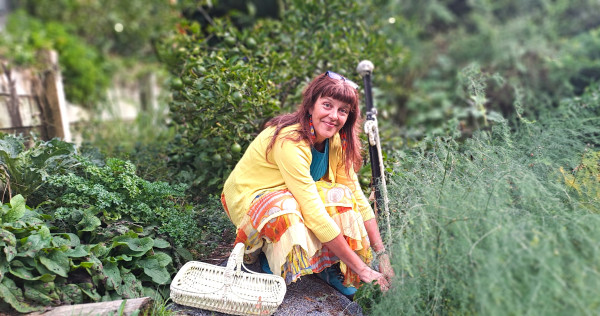
Caption: Shari Corbett-Dwyer tending to her home garden
Communal approach entices new gardeners
Shari – a professional hair stylist, jewellery maker and all-round creative with her own businesses and studio – discovered her green fingered inclination a few years ago. During the COVID lockdown in 2020 she decided it was time to tackle her neglected garden. Talk of food shortages added to her motivation.
Before then, her gardening technique? “Just put it in the ground, good luck and walk away. I didn’t really have any knowledge. Sometimes it would work, sometimes it wouldn’t.”
She set up a communal garden at a property around the corner from her Welbourn home after she completed a horticulture course through education provider Land Based Training. “I loved working in the garden alongside people and I learned so much.”
“I wanted to do it for people who didn’t have space for a garden or didn’t know how to garden.”
The communal garden, formed three years ago, comprised eight keen gardeners who worked a couple of hours a week and shared the harvest. When she read about the Bishop Action Foundation scholarships to study organic primary production at WITT, she had a strong instinct it was the next step for her. Doing the Level 4 programme gave her the confidence and know-how to pursue her communal garden vision on a bigger scale and she launched GROWMEEZ – with the support of Sustainable Taranaki. The name is a play on ‘homies’ – slang for close friend, companion, trusted buddie.
She’s now coordinating five communal garden groups with three more waiting to join the scheme. Her role involves running workshops on seed saving, composting and other topics while participants are sharing recipes and harvesting ideas and even planning garden roadies and garden-themed movie nights.
Communal gardens differ from community gardens, she explains, in that that they are privately owned but the mahi and produce is shared. Participants contribute a small weekly fee of $7 to cover the costs of seeds, soil improvements and tools.
While there are community gardens all over the region, Shari’s idea is “Soil connection and people connection, and for people to be able to walk or travel to their local garden for fresh produce,” she adds.
“My goal now is for every neighbourhood to have a communal garden. It’s a no-brainer.”
Simon Cayley (Chief Executive Officer at Bishop's Action Foundation) believes Alex and Shari’s experiences and successes highlight the reason his organisation is backing the course. “It’s not just learning about growing food, it’s about the systems and the business skills and how you utilise it. WITT’s primary production course is contributing to the flourishing of Taranaki’s food future.”
And as WITT's horticulture tutor Carl Freeman points out, the cost of artificial fertilisers is going up astronomically because of oil shortages and supply chain issues caused by Middle East-US conflict.
“The skills these students are learning might be super important with the cost of fertilisers becoming unaffordable there will be more and more farmers wondering how we can grow [produce], and these organic methods and skills give an alternative.”
Caption (top): Carl Freeman (left) with Alex McDonald and Simon Cayley presenting Alex with her Special Award for Top Student (from the 2025 NZ Certificate in Organic Primary Production)