

Proud trainee builders nail new house
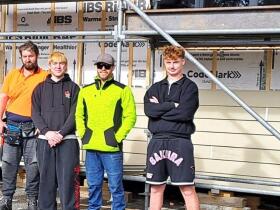
Ihaka Timu-Keefe has always dreamed of being a builder. This year he’s gone from building bird houses at home to building a house for people.
By the end of August, he and his classmates had nearly finished building a three-bedroomed weatherboard home on the WITT campus. It is currently on the market for sale.
Ihaka, aged 17, is one of 22 students (18 guys, four women) enrolled this year in the New Zealand Certificate in Construction Trade Skills (Level 3) at WITT. About three quarters of the group are under 20, the youngest 16 and the oldest is 40.
Next to the workshop equipped with a plethora of carpentry tools and machinery sits the house they’ve been working on since February.
Amid the clatter of hammering, saws, and drills, he and classmate Baden talk with pride about all they’ve learned at WITT this year, including a range of tools such as drop saw, skill saw and hand saw.
“I wasn’t really doing well at school,” says Baden, also 17. “It wasn’t really my thing. I did Trades Academy at WITT last year and did well – got top of my class in the Build a Bridge programme.”
Baden, also worked on a project at school to build a new classroom, which inspired him. “I fell in love with building, so I decided to leave school and come and do this. It’s better for me here because I’m better working with my hands.”
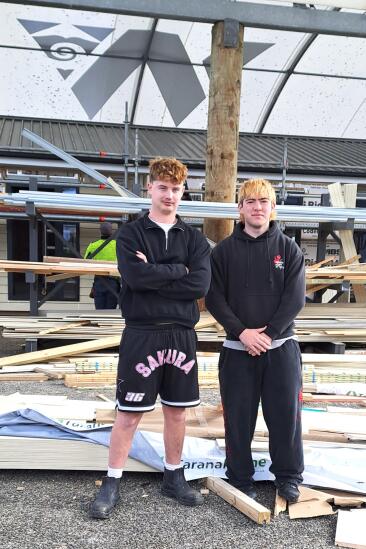
Caption: Baden Graystone and Ihaka Timu-Reefe
It’s a reality that resonates with many students enrolled in trades training.
Ihaka says he’s always had a passion for working with his hands. “It’s been my dream to be a builder, so I decided to come to WITT to get a certificate and hopefully go on to an apprenticeship.”
He’s had an introduction to carpentry by helping his family build fences for a farm, as well as bird houses (or feeders) for family members too.
“Because they know I’m doing the course I’m the first person they go to for help when they want something built.”
His insights on the difference between “school maths” and “building maths” highlights how practical application of traditional subjects in a trade can make learning meaningful and motivating. “I love building maths more than school maths – it’s way better and I can understand the building side of maths.”
The house is fully insulated and lined with completed wiring, and has three bedrooms, a walk-in wardrobe, one bathroom, two wharepaku. The exterior is a mix of horizontal timber weather boards and vertical shiplap weatherboards. It is built to NZS 3604 (the building code) and comes with the exterior completely painted. It’s the fifth such house constructed by WITT students on campus.
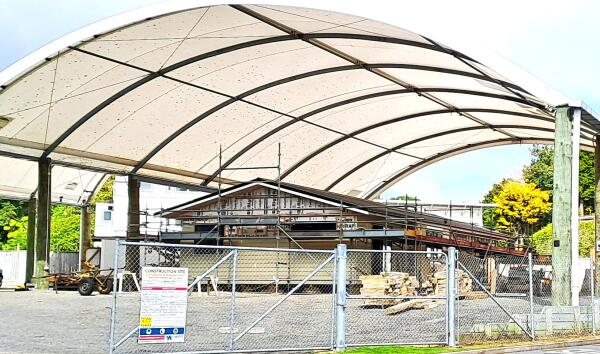
Built to code
“The house is no different to a house built in industry,” says tutor Stacey Hill. “It goes through the council consenting process and is required to pass all relevant inspections just as any build would.”
He has a hunch it might even be better. “We don’t have the same time constraints, so we have the time to make sure things are great! I am also a licensed building practitioner, so my license is on the line with every house built. The students don’t know the short cuts, so we have the chance to encourage high standards as a base line.”
Despite that, they are three weeks ahead of schedule.
The level three programme is comprised of eight courses, including health and safety, tool use and building techniques that the students progress through as they build.
“We run the site just as a commercial building site would be run in the community,” Stacey says. “We have a wide range of modern power tools and hand tools that they would encounter on a site. Keeping the students up to speed with technology and current building techniques involves giving them the opportunity to use the gear,” he says. This approach aligns with the views among industry players and other training providers on best training practices.
He says most of his students are practical learners. “Some have come directly from school so going back into a classroom becomes a drag. However, we keep our theory lessons short and with the help of a new unified programme that focuses on practical evidence rather than hours of theory we’ve been able to keep them focused and it seems to be working well.”
“The students turn up pumped and ready to go each day. The chance to build a real project is one of the drawcards,” Stacey adds. “I lean into their excitement and use it to build a sense of pride for our whare.”
Women on the team
Abby Wallis is one of four women on the course and is in her element. She says the rewards of the hard work on site include “Seeing the progress – it’s amazing.”
She enjoys the precision of building and getting the measurements exactly right and says she has learned to be patient through fitting weather boards.
But the key satisfaction is; “the sense of pride seeing the house come together and thinking ‘we did that’.”
At the end of the course, she wants to apply for an apprenticeship. “It’s about finding right company that respects you. It can be harder for females. You have to prove yourself, that you’re better than males.”
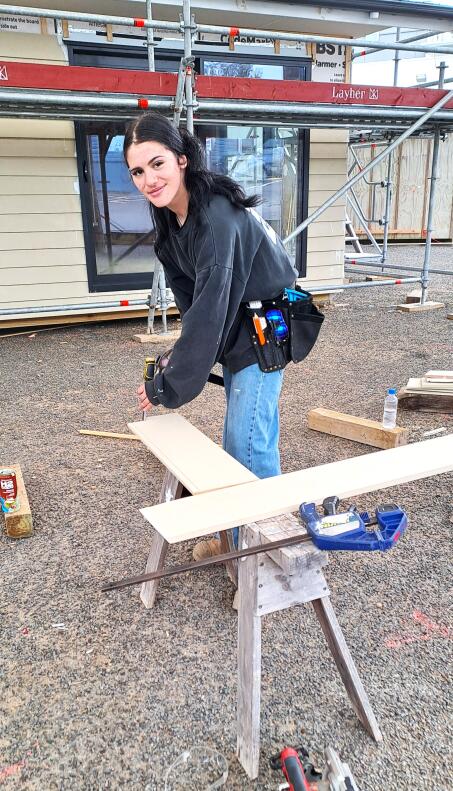
Caption: Abby Wallis has found her calling as a builder
Ihaka is intending to move to Brisbane where he has whānau, and to become an apprentice builder while Baden is off to Christchurch where his sister lives. He thinks there could be more opportunities for apprenticeships and work there.
Highlights of the year for Ihaka have been working with machinery and seeing the results of teamwork. “I’m feeling really proud of the progress we’ve made so far. And how far we’ve come.”
In terms of future changes in the sector, he’s not worried about AI. “AI can’t take over being a builder – we’re pretty safe.”
Safe as houses, as the saying goes.
The house is advertised on TradeMe: