

Māori health focus at WITT research hui
Teaching is over, exams and marking too. So, WITT staff got together to end the year sharing details of research they’ve been conducting throughout the year.
Māori tikanga in trauma-informed care and nursing practice, international student success and professional development were among research topics by kaimahi presenting at Hui Kōrerorero Rangahau.
The hui opened with keynote speaker Matt Lamb, Strategy and Investment Lead at Te Puna Umanga Venture Taranaki. Matt shared insights about where the Taranaki economy is heading, how Venture Taranaki is planning for change and why training institutions like WITT are central to the region’s future prosperity.
Matt highlighted shortages of skilled staff in some sectors and the need to identify skills and training required for jobs of the future. Venture Taranaki is focussed on four key areas for regional economic development – energy transition, agri-food diversification, biotech innovation and advanced manufacturing.
Delving into Pōwhiri for wellbeing
The Pōwhiri as a framework for trauma informed enquiry was the topic of the first presentation by Tuari Reweti (Kaitakawaenga – Pastoral Support) who took home the People’s Choice Award at the end of the day.
Tuari gave a compelling kōrero about the use of the pōwhiri process as a trauma-informed framework for engagement within education, health and social service settings. His findings are based on a workshop he’s been presenting as the concluding session of WITT’s Trauma-Informed Care micro credential, which attracts students from health, education, justice, police and corrections sectors.
Learning opportunity for nurses at Te Matatini
Providing health checks at Te Matatini (national Kapa Haka cultural festival at the Bowl of Brooklands in February this year) offered a clinical placement opportunity with rich cultural learning experiences for nursing students and tutors.
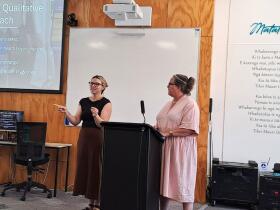
Nurse educators Casey Trownson and Helen Bingham presented their qualitative research on these experiences. It has been published in Nursing New Zealand’s Kaitiaki journal and is titled: Māori health comes alive for nursing students at Te Matatini.
“Nib [health insurers] invited the school of nursing at WITT to be part of the Te Matatini festival, to provide blood pressure and HBA1c [blood sugar] health checks. Over the five days, nursing students (ākonga), with the support of nursing lecturers, provided 419 health checks — 119 on one day alone,” the research report says.
“While the physical health of the person was the catalyst for each interaction, it became apparent that there were opportunities at the same time for brief holistic, culturally safe assessments and interventions that may have made a difference to Māori health outcomes.”
The experience aligns with changes to standards by Te Kaunihera Tapuhi o Aotearoa — the Nursing Council of New Zealand to ensure these meet the need for a culturally competent workforce.
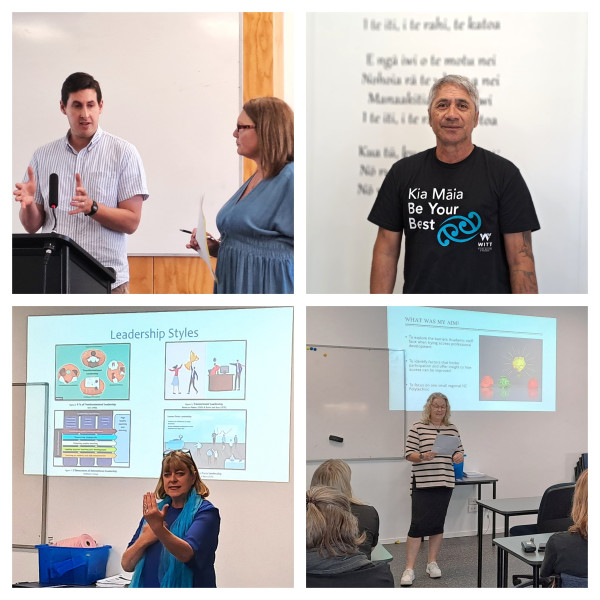
Caption: (Clockwise from top left) Matt Lamb with Tara Malone; Tuari Reweti; Michelle von Pein and Phillipa Watt.
Professional development barriers
Michelle von Pein, Corporate Services Coordinator, shared results of mixed method research she’s done for her Bachelor of Applied Management on barriers academic staff face when trying to access professional development.
An online survey of a broad section of WITT staff revealed two key barriers: time constraints and cost. Face-to-face interviews revealed a different perspective. “Many participants were in disciplines where PD is tied to professional registration, compliance or regulatory requirements. This group viewed PD less as a developmental option and more as an essential professional obligation,” Michelle says.
International student focus
Business tutor Phillipa Watt’s study investigates the relationship between leadership approaches and international student outcomes at WITT.
Drawing on staff and student surveys, focus groups and institutional document analysis, she explored four different teaching leadership styles that influence student engagement.
“The study highlights that Western-centric leadership models alone are insufficient to address the complexities of multicultural vocational education,” she says.
Culturally responsive practice and clear communication are among critical approaches to ensure international students flourish as learners.
Other presentations included Coral Tamblin, Nursing Lecturer, who presented her findings on changing teaching practice to improve ākonga outcomes in Safe Medication Administration Assessments, and Trish Sison who is exploring if there is a link between exercise and wellbeing as part of her master’s study.
Tara Malone, Chair of the Research Committee and Research Officer, said the hui was a huge success.
“Attendees felt invigorated and inspired after a tough year at the organisation. It was wonderful to see new and emerging researchers have an opportunity to showcase their hard work,” Tara says. “Presenting research can be anxiety-provoking but at the same time really rewarding.”
“Matt Lamb from Venture Taranaki provided us with food for thought about future directions and we are poised at WITT to continue developing as an innovative ‘think tank’ for our rohe by creating a research pipeline from kura to mahi,” she added.
“Next year we intend to go bigger with our research hui and plan to involve our high schools, ākonga and stakeholders. The future is bright but must be underpinned by knowledge.”
Caption: (top) Casey Trownson and Helen Bingham sharing their research findings on nurses' experiences doing health checks at Te Matatini .