

Growing interest in hemp for housing
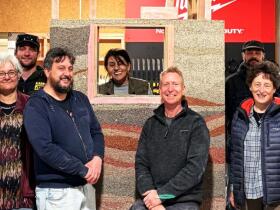
An Australian expert visited Taranaki recently to run a weekend workshop at WITT to teach builders about using hempcrete in construction, signalling a growing local interest in the fibrous plant for housing.
Australian Hemp Masonry Company’s managing director Klara Marosszeky flew to New Plymouth to run the introductory workshop in partnership with Te Puna Umanga Venture Taranaki, the regional development agency, at WITT.
The course is part of the wider Taranaki Hemp Hub project, building a local hemp fibre value chain from crop to construction. New hempcrete building projects are already in the pipeline. Two similar workshops were held last year with Te Puna Umanga Venture Taranaki.
Local participants as well as builders from the Coromandel Peninsula, Te Puke and Kapiti Coast attended the recent workshop having completed online theory prior to the practical session. During the weekend they learned how to create a wall from processed hemp fibre, or hurd, which is mixed with a lime-based binder to form a slurry to put into a framework.
WITT carpentry and joinery tutor Phil Richardson-Jones, who’s been involved with these workshops, is excited about the opportunities for Kiwi builders interested in hempcrete. He is keen to learn about hempcrete construction so that he can offer specialist training at WITT in the future. He also envisages students enrolled in trades training having the chance to learn about hempcrete too.
Hemp hub in Taranaki
Phil is impressed with the numerous qualities and benefits of hemp and its strength and durability. Used for centuries in building, fabric and rope, hemp is one of the most sustainable materials, he says. It is fast growing, often requires no pesticides or herbicides and is carbon negative. Lightweight, breathable, thermally efficient and naturally non-toxic, it’s suitable for insulation, floors, roofing and for making new or upgrading existing structures.
These days, hemp products – based on hemp oil, seeds and powder - are revered as nutritionally beneficial and found in a range of food and beauty items.
While hemp is more widely used in Australia for housing and construction, it is still very new here. Phil says he can see the potential for Taranaki to become a ‘hemp hub’ of production, thanks to Venture Taranaki’s Branching Out project to encourage diversification in food and fibre alternatives to traditional land use. Hemp is one of the crops currently being trialled, along with kumara, garlic and angelica, among others.
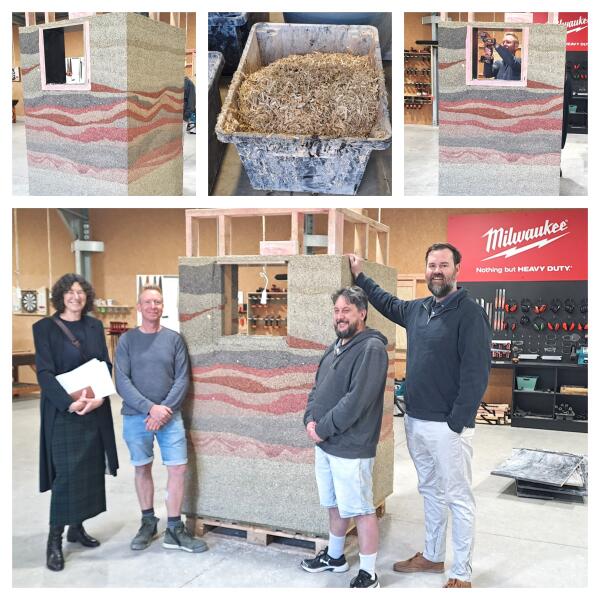
Hemp focus at Parihaka
In a precursor to the Saturday workshop, Friday’s Kāinga Rau – Whenua to Whare wānanga at Parihaka (run by Pā Kids in partnership with Venture Taranaki) - hemp experts and enthusiasts shared a range of hempcrete opportunities and developments.
Klara Marosszeky spoke about hempcrete for new housing, retrofits and community-led builds and how far Australia has come. She is a globally recognised leader in hempcrete construction and has worked in the sector since 1999. Her experience spans hemp growing, research, product development, professional training and hundreds of real-world building projects.
Local hemp homeowners Matt Low and Melissa Burleigh shared their practical experience of building and living in their hemp home for 11 years.
Agronomist Nick Pyke spoke about the suitability of growing hemp in Taranaki conditions, while Venture Taranaki outlined the regional ecosystem already developing around hemp growing, processing and building capability.
Timothy Steedman, from South Taranaki District Council, covered consenting and regulatory considerations, and Eve Kawana-Brown (representing Venture Taranaki and Massey University) spoke on housing health, building performance and possible future hempcrete research projects.
Conversation to crops and construction
Branching Out Project Manager Michelle Bauer says; “Hempcrete provides a practical starting point for establishing a wider hemp fibre industry in Taranaki.”
“Our recently released Hempcrete Development Plan shows that developing construction capability and building a pipeline of projects will be essential to create a viable industry. Courses like this help turn interest into the skills and confidence needed to deliver those projects.”
Sean Markham, Business Development and Regional Engagement Lead at WITT says it was “very fortunate to have someone of Klara’s international standing in Taranaki, first sharing her knowledge at Parihaka and then directly training participants during the practical hempcrete construction course at WITT recently.”
“The progression from last year’s WITT course to a broader wānanga at Parihaka shows the conversation is moving beyond initial awareness and into possible real-world applications, he says. “The presence of past course participants who are now involved in planned hempcrete builds is a strong sign that the training is beginning to translate into action.”
Taranaki now has a pilot-scale hemp processing facility based in Bell Block, which Venture Taranaki established with funding from the Three Waters Better Off Grant, Sean added.
“This is an important part of developing a regional hemp construction industry because it allows locally grown hemp to be processed closer to where it is grown and where it may eventually be used.”
Top three reasons to use hemp:
· Healthier and more comfortable homes
Hempcrete can help maintain a more consistent indoor temperature, regulate moisture and reduce the conditions that contribute to mould.
· A lower-impact and less wasteful approach to construction
The construction sector uses large volumes of materials and creates significant waste. Hemp offers the potential to grow a building material locally, process it locally and use it in homes, with minimal waste and while creating opportunities to find productive uses for other parts of the plant and processing residues.
A regional circular-economy opportunity
Hemp could connect local farming, processing, building, research and education. The fibre and hurd can be used for construction and other products, while suitable residual biomass could potentially be converted into sustainable products such as biochar. This creates the possibility of using more of the crop and retaining more value within Taranaki.
Want to learn more? WITT offers programme(s) for anyone interested in construction:
Caption (top image):
Pictured are Klara Marosszeky - Managing Director, Australian Hemp Masonry Company (window of hemp frame), Phil Richardson-Jones - WITT tutor (front to right of window), Michelle Bauer - Branching Out Project Manager, Venture Taranaki (far right) and Eve Kawana-Brown - Massey University Business Development Manager, Venture Taranaki (far right, second row) with attendees at the workshop at WITT.