

Fiordland epic adventure for pest ops students
‘An ancient atmosphere that touches people. A huge, prehistoric, Jurassic Park. A wet and scary place. Like the Amazon on top of the Himalayas’ - some of the vivid descriptions of remote Fiordland, where three WITT students went over the summer to carry out pest operations in extreme conditions.
Learning how to get rid of harmful predators is ideal work for people who love being out in nature. Being helicoptered into deepest Fiordland for a three-day expedition was a chance of a lifetime for Sarah Campbell, Zack Hutchinson, and Chris Sheahon. All three graduated last year with the New Zealand Certificate in Pest Operations (Level 3).
Pest Operations tutor Dan Waterson brokered the adrenaline-rich adventure with Roy Sloan, who set up and leads the Fiordland Wapiti Foundation. It’s a conservation organisation that manages the iconic Wapiti deer herd along with pest operations to control rats, possums and other predators of native flora and fauna.
Roy had long wanted to partner with an education institute to offer experience in one of the wildest, most challenging areas of Aotearoa’s natural environment. He and teams of volunteers are caretakers of 175,000 hectares known as the Wapiti blocks of Fiordland, which Roy describes as “rough and unapologetic” – frequented only by hunters and sometimes, conservation and pest ops specialists.
Dan, who leads and teaches the country’s only polytechnic-based pest operations programme, had travelled south to assist Roy in 2023 for professional development. The pair discussed the potential of getting pest ops graduates involved. Dan shared details of the experience and put the idea to his class at the start of last year. Planning, fundraising, and deciding who would be the lucky ones to go unfolded over the year.
Then in December the chosen three went south, flown in by helicopter to set up predator control traplines in the upper and lower Glaisnock River valley catchments Fiordland. Their mission was to replace retired traps, a ‘next level’ experience from anything they’d done before, says Dan.
The WITT team got to hear Wapiti deer calling during their excursion - one of many ‘WOW’ moments. They scaled risky slopes, carrying their entire kit of gear plus heavy traps, while navigating steep, rocky gorges and crossing rivers. “We ate Back Country Cuisine freeze dried meals, set up tents along the way, and were forced to seek refuge in the famous Glaisnock hut, as a storm was brewing, and heavy rain was forecasted,” Dan recalls.
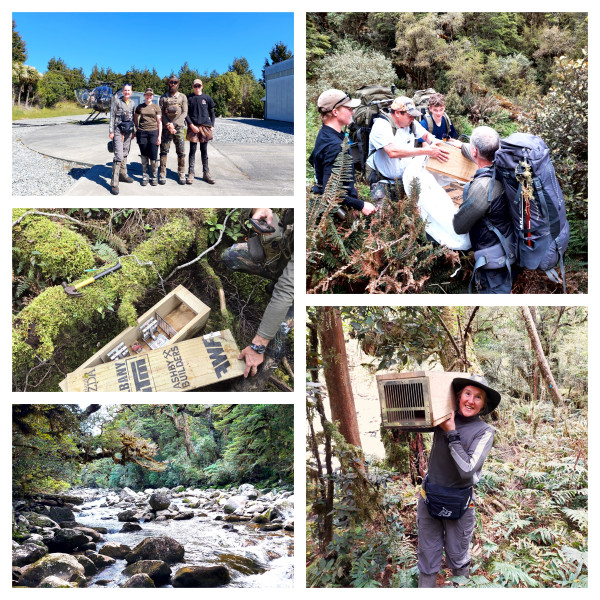
Caption: Tough gig carrrying heavy traps around steep Fiordland Forest
Trading office life for the outdoors
Torrential rain on the final day didn’t deter progress or the team's spirits, according to Sarah Campbell. She recently stepped away from corporate life as a project manager to pursue her passion for the outdoors, initially taking a sabbatical to complete a pest operations course at WITT and expand her conservation volunteering experience through a range of field opportunities.
Sarah, who was presented with a special award from Department of Conservation at the 2026 Graduation ceremony, had been volunteering with various Taranaki trusts and organisations for several years in her spare time, including tasks such as maintaining and rebaiting traps in the Kaitake and Pouakai Ranges and monitoring kiwi.
“I reached a point where I wanted to be doing this all the time,” she says. “This [pest operations and conservation] work fills me up. "The jobs I’ve had before were fantastic opportunities. But now, I feel like I’m doing something to help the future of New Zealand. There’s so much that needs to be done,” says Sarah. “I can’t thank the WITT tutors (Dan Waterson and Georgina Ngametua) enough for all their support, knowledge, enthusiasm and encouragement. I wouldn’t be doing what I am today without them".
“Over the past year, I’ve had the incredible opportunity to contribute to conservation projects, volunteering and now working as a Ranger for the Department of Conservation, all of which have deepened my understanding of environmental challenges and solutions.”
This work includes several projects in the South Island including the Marlborough Sounds (Pelorus and Kenepuru Sounds), searching estuaries and coastlines for the highly invasive coastal weed spartina, as part of an eradication project. “I’m currently on Maud Island focusing on weed control on the scientific reserve and will soon head into the high country to carry out native snail monitoring.”
She is planning to do the New Zealand Certificate in Environmental Management (Level 5) next year.
Hunting as pest control
Chris Sheahon and Zack Hutchinson both had prior experience as hunters and – like Roy - are keen to see hunting and culling as part of a broader conservation approach in Aotearoa.
Chris enrolled in pest ops after returning from Canada where he’d spent time deer hunting in British Columbia. He jumped at the chance to join his classmates and Dan on the trip to Fiordland, which he says reminded him of the Canadian wilderness with its majestic mountains – minus the moose, bears, wolves and cougars.
He’s seen the damage to native forest here from deer, chomping through young shoots and waist-high trees and decimating the next generation of new plants.
Now in his 30s, he was looking for a new direction having worked in trades doing tiling and flooring. His qualification is enabling him to pursue a lifestyle he’s dreamed of – being out in the bush away from “the dust, noise and dodgy materials” of indoor trades.
Based in Whanganui, Chris has been deer culling in a Taumarunui forestry block. He thinks hunting and trapping are the best methods for pest control and he’d like to see recreational hunters become more knowledgeable and involved in conservation impacts of hunting as a tool to reduce predators and pests.
Zack grew up on a farm and is a keen hunter. He wasn’t sure what he wanted to do after finishing Year 11 at Stratford High School and considered shearing. “I’d heard about the pest operations course, and it felt like the right choice for me. The course has been fun, and Dan is the best tutor.”
The Fiordland trip was “very challenging – steep, rocky, gorges and rivers” but rewarding and memorable. Zack now works for Nateva (formerly New Zealand Carbon Farming) culling deer, goats and pigs and maintains traplines in regenerative forests across New Zealand.
Sarah says, “stepping away from the usual routine to follow a passion can open doors in unexpected ways. What started as a personal quest to make a difference has become a clear pathway to professional growth — one that I’m excited to continue pursuing.”
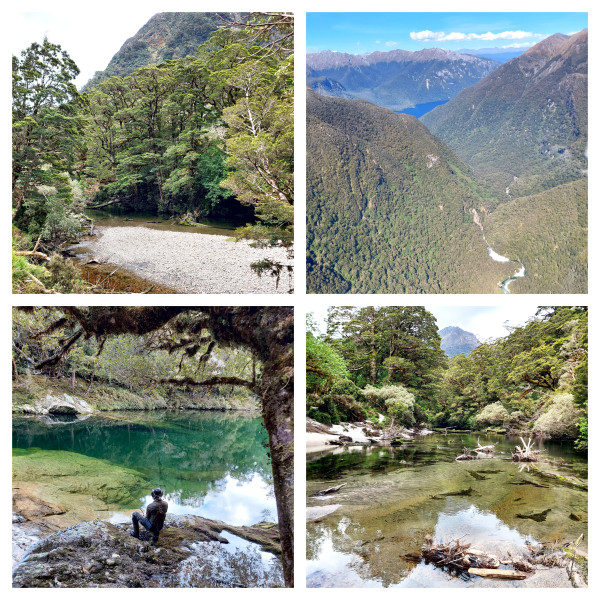 Caption: Time in the beautiful, remote wilderness of Fiordland was challenging and life-changing for WITT pest ops students.
Re-imagining predator control in a harsh environment
Fiordland is life-changing because of its magnificence, scale, remote location, and the extreme weather conditions, Dan says.
“It overwhelms people,” says Roy, a veteran of the region. “They don’t come out the same. It’s such a huge, prehistoric, Jurassic Park – a wet and scary place. It possesses an ancient atmosphere that touches people. They are stunned by the scale and feel vulnerable at the harsh weather and heavy rain. It’s very steep – like the Amazon on top of the Himalayas. It’s prone to slips and sits on a quake faultline. There’s rain and snow, and it’s hammered by southerlies – it’s where our weather is born.”
Dan reflects that Roy’s leadership, depth of knowledge, and generosity left an enduring mark on the entire group. “More than just practical skills, he imparted a fundamentally different way of thinking about conservation — one grounded not in raw numbers, but in ecological outcomes.”
“Rather than chasing the often-unrealistic goal of complete eradication, Roy emphasised the importance of understanding, monitoring, and managing impacts to sustain ecological balance,” says Dan. “His approach recognises ecosystems as dynamic, interconnected systems, where success is measured by resilience and function, not simply the absence of pests or predators.
“This perspective has profoundly challenged and reshaped the way both our students — and me — understand and approach pest management in New Zealand.”
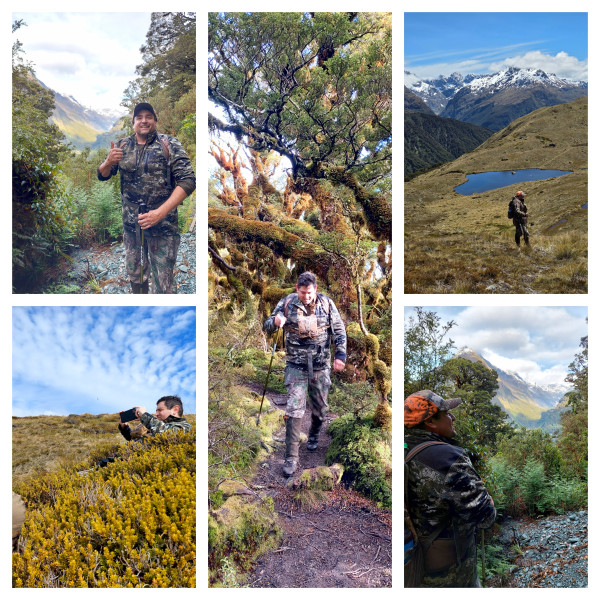 Caption: Tutor Dan Waterson in his element during the pest operations mission
Back story on Wapiti deer
The foundation’s project is unique - conservation management based on recreational hunting and food processing. Roy works with hunters to keep the deer population under control because they feed on young trees, ferns, and ground cover plants.
The prized Wapiti deer (or North American elk - second in size to moose) were introduced to the region from North America in 1905, when 18 of the species were released at the head of George Sound, Fiordland and became quickly established. Ten of these animals were a gift from American President Theodore Roosevelt, the balance purchased by the New Zealand government.
In a complementary project, Roy recently launched a fundraising campaign to achieve his vision of setting up a facility in Te Anau to process wild deer meat from the Wapiti herd culling operations. His charitable trust estimates that sales of venison from the plant will help fund deer control operations while providing top quality meat for both high-end restaurants as well as food banks around the motu. BurgerFuel also has a Wapiti pattie on its menu!
Roy’s conservation approach is a departure from that of many conservation groups because he thinks the predator-free vision is not achievable – at least in Fiordland, a vast and mostly inaccessible region of extreme contours and climatic conditions. Instead, he focusses on impact - suppression of predators at a level that allows native plants and animals to thrive. “We don’t have the tools to completely eradicate all of these predators,” he says.
“Training people to kill animals for the past 100 years has not been successful in eliminating them. The numbers are higher than ever. We’ve learnt nothing.”
“We need people to upskill in management not just killing pests – deer are different to other pests. We need to understand deer ecology and their use in feeding humans.”
Dan is planning for another group to head to Fiordland at the end of this year.
“In Fiordland we observed firsthand the outcomes of long-term, well-managed conservation work,” Dan says. “We saw thriving Whio (native blue duck) populations, healthy river systems, and an abundance of native birdlife - tangible evidence of what collaborative, hunter-led conservation can achieve in some of the most challenging terrain in the country.”
To find out more about studying pest operations, conservation, and environmental management at WITT: https://www.witt.ac.nz/study/environmental/
Caption (top photo): WITT pest ops students ready for Fiordland (from left) Sarah Campbell, helicopter pilot, Chris Sheahon and Zack Hutchinson.