

Cow connection at the heart of farm life
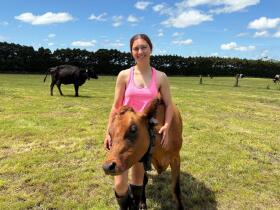
Sahkyla Graham knew plenty about day-to-day farming work before she enrolled at WITT as a high school student last year, having grown up on a South Taranaki dairy farm.
But she’s deepened her knowledge of topics like animal behaviour, biology and diseases and learned about digital apps for managing and monitoring animal health.
She’s spent the past few months in her first farming job near Kaponga and dreams of her own dairy farm one day.
Despite her lifelong experience and love of farming and cows, Sahkyla, 18, is enthused by her new discoveries about the world of agriculture.
“There’s so much to know, for example about grass and feed - it’s not all about the milk. You need to understand soil health and how that affects grass quality and milk.”
Bovine body language is another important aspect. How do you identify if a cow is happy, stressed or unwell? “The position a cow is lying in tells you a lot. If it’s sitting up and ears up, it’s happy and comfortable. Cows show a lot of emotion through their ears and eyes.”
“A big thing that’s helped me is learning to identify mastitis (bacterial infection of the udder) and lameness. There are many different symptoms for mastitis – heat from udder, a pink and swollen appearance.”
She is impressed by the role of digital tech, such as electronic collars which can pinpoint if cow is not eating or walking normally. These are monitored via the MyHalter app on a cell phone. Using smart collars connected via an app, the technology enhances livestock management for virtual fencing to monitoring animal health. It can track heart rate, vocal sounds or walking pace and is useful in breeding season to identify when heifers are ovulating.
Tech for animal health
While she learned much of the practical side of milking cows on the Opunake family farm of 146 hectares and 484 cows, Sahkyla has been sharing her new knowledge with her father, Robert Gilligan.
“My dad loved it when I’d come home from WITT with new information,” she says. “I’m really happy that I came to WITT for this reason.”
She’s been teaching him about new farming tools, technology and uses of social media – things he was unfamiliar with. Now he realises social media can be educational as well as useful in creating a supportive community among farmers.
She has also learnt more on the mechanical side of farming such as operating a tractor, farm bike and chainsaw, including safety and maintenance.
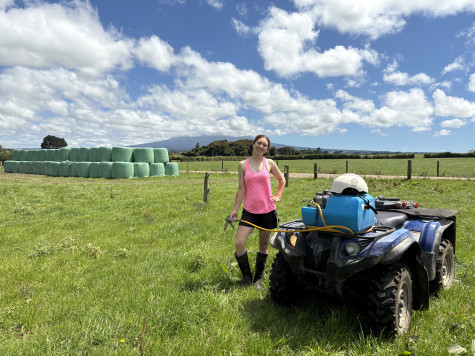
Cows are not just milk machines
“Being around the cows is a massive part of why I do what I do. Just love watching them – you get to play a big part in helping them grow and reach their potential.”
For Sahkyla, a cow is “not just a number” but a creature with its own personality and expressions. “They like being around humans, they love the attention and being hugged and patted. That’s a huge factor in farming that’s not well understood – the one-on-one contact with farm animals and understanding them.”
“As a farmer you do your best to make sure that every single cow is as healthy and happy as it can be, whether dairy or beef cows.”
Sahkyla will graduate this week (13 February) with a New Zealand Certificate in Primary Industry Operational Skills (Level 3) which she completed part-time while a student at Opunake High School through the Secondary Tertiary Pathways programme. She will study this year for a New Zealand Certificate in Farming systems (Level 3).
She’s keen to stay in Taranaki and hopes to own a farm one day, possibly with her older brother, who is currently farming in Norfolk, Taranaki.
She was glad of the chance to pursue her dream while she was still a Year 13 high school student. “WITT is an amazing place – there are so many opportunities for so many different careers. I’ve really enjoyed my time, and I’ll be returning this year. I don’t think I’d be where I am now if it wasn’t for WITT.”
Her tutor Adrian Edser says Sahkyla completed her dairy farming course to a very high standard, consistently demonstrating a strong work ethic, reliability, and a genuine interest in the industry.
“Farm training is a great option for young people because it offers hands-on experience, clear career pathways, and the chance to earn while learning,” he says. “It builds practical life skills such as responsibility, problem-solving, and teamwork, while also contributing to a vital industry that supports food production and rural communities.”
Farming is a lifestyle for Sahkyla. “It helps you grow as person, things like – responsibility, family connections and work ethic.”
While she embraces digital innovations like MyHalter, farming is her antidote to the lure of social media and addictive scrolling.
Getting up early is a good way to start the day, she reckons. “By the time you’ve done the farm work (milking) you feel fresh and awake, ready for the day. It’s quiet and peaceful, and there’s fresh air.”
For more information about agriculture programmes at WITT: https://www.witt.ac.nz/study/primary-industries/agriculture/