

Scholarships for organic food growing are timely for Taranaki
Scholarships offered by WITT to support those wanting to study organic produce growing are now open for the third year. The opportunity coincides with heightened concern over food security amid rising fuel prices caused by war in the Middle East.
Ten scholarships, valued at $1500 each, are available for people interested in learning about organic primary production and the deadline to apply is May 31. The financial support for organics training is a welcome boost on the path to transforming Taranaki into a future food bowl, says the course tutor Carl Freeman.
The scholarships came about through a partnership with the Bashford Nicholls Trust and the Bishop’s Action Foundation to fund scholarships for the Level 4 New Zealand Certificate in Organic Primary Production.
Carl says WITT is proud to be a leader in teaching knowledge and skills that “contribute to more diverse food production, and that will help to position Taranaki as a sustainable food producer.”
The current fuel crisis sparked by war in the Middle East is a reminder of the importance of developing resilience through sustainable local food for the long-term, he says.
He recently published a thought piece in the Taranaki Daily News on the value of horticultural skills and organic growing systems and methods to decrease dependence on imported food and fertilisers. As well as local farmers’ markets, community gardens and orchards, and crop swap initiatives, learning to grow food for whānau and community will become increasingly relevant, he says.
Opening doors – organically
Alexandra McDonald, recipient of the first round of scholarships in 2024, says the scholarship was a turning point in her life. She also received the Bashford-Nicholls Trust Award for Top Student (worth $500) for 2025.
“Receiving the scholarship meant a lot to me – it felt like a real belief in my potential at the right time,” she says.
“Since then, I’ve worked hard to make the most of that opportunity, completing Level 4 [New Zealand Certificate in Organic Primary Production] with top marks and receiving the top student award. That feels really special, knowing it came from the support that the scholarship provided.”
Now working at Coastal Market Gardens, Alexandra is continuing to develop her skills in organic, small-scale market gardening with a focus on producing nutrient-dense food, including micro-greens, for the local community.
Simon Cayley, Chief Executive of the Bishop’s Action Foundation, says the success of students like Alexandra reinforces the strength and value of the partnership between WITT and the trust. “The more we build the capacity and skillset in the region, the more we’ll see better outcomes.”
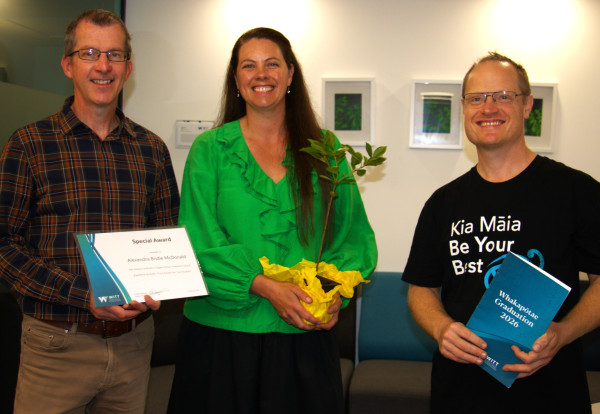
Caption: Alexandra McDonald receiving her Special Award for Top Student with Simon Cayley (Bishop's Action Foundation) and Carl Freeman (WITT tutor).
Organic growing – lifestyle to lucrative small business
The Level 4 programme with ten scholarships available is one day a week on Fridays at WITT for 34 weeks. “It’s ideal for anyone seeking a new direction and lifestyle, whether to fulfil personal goals with their own garden, or with business aspirations in the science of organic growing for community or commercial gardening,” says Carl.
The course covers soil management and how crop requirements can be satisfied organically, whilst actively producing vegetables, fruit, and herbs over a full growing year.
“Our region already has a rich horticultural history,” he says, referencing Duncan and Davies nursery – once New Zealand’s largest, founded in the late 1800s - and other nurseries, as well as commercial berry, Kiwi fruit and avocado production, and multiple market gardens.
Australian-born Carl is well-known in Taranaki for his enterprising urban and community agricultural projects and his leadership and expertise in encouraging local food production and farmers’ markets. He was chairperson of the Taranaki Farmers Market Trust until recently.
- The deadline to apply for a scholarship is May 31.
- For more info contact: [email protected]
- Find out more about primary production, horticulture, and organic growing courses at WITT
- The New Zealand Certificate in Horticulture (Level 3) is fees free.
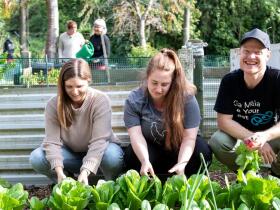
Caption (top): Horticulture tutor Carl Freeman (left) with students at the campus organic gardens.